Phase-2 Stability Validation
Quantitative validation of rotational damping and trajectory repeatability under controlled disturbance injection.
- Reduced rotational variance
- Bounded angular magnitude
- High trajectory overlap
- Low RMSE across runs
RMSE Ω,mag0.1203
Var(ωx)0.00677
Var(ωy)0.00769
RMSE Pos,Z0.3661
3.0076
RMSE X
3.8208
RMSE Y
0.3661
RMSE Z
0.1203
RMSE Ω
0.00677
Var ωx
0.00769
Var ωy
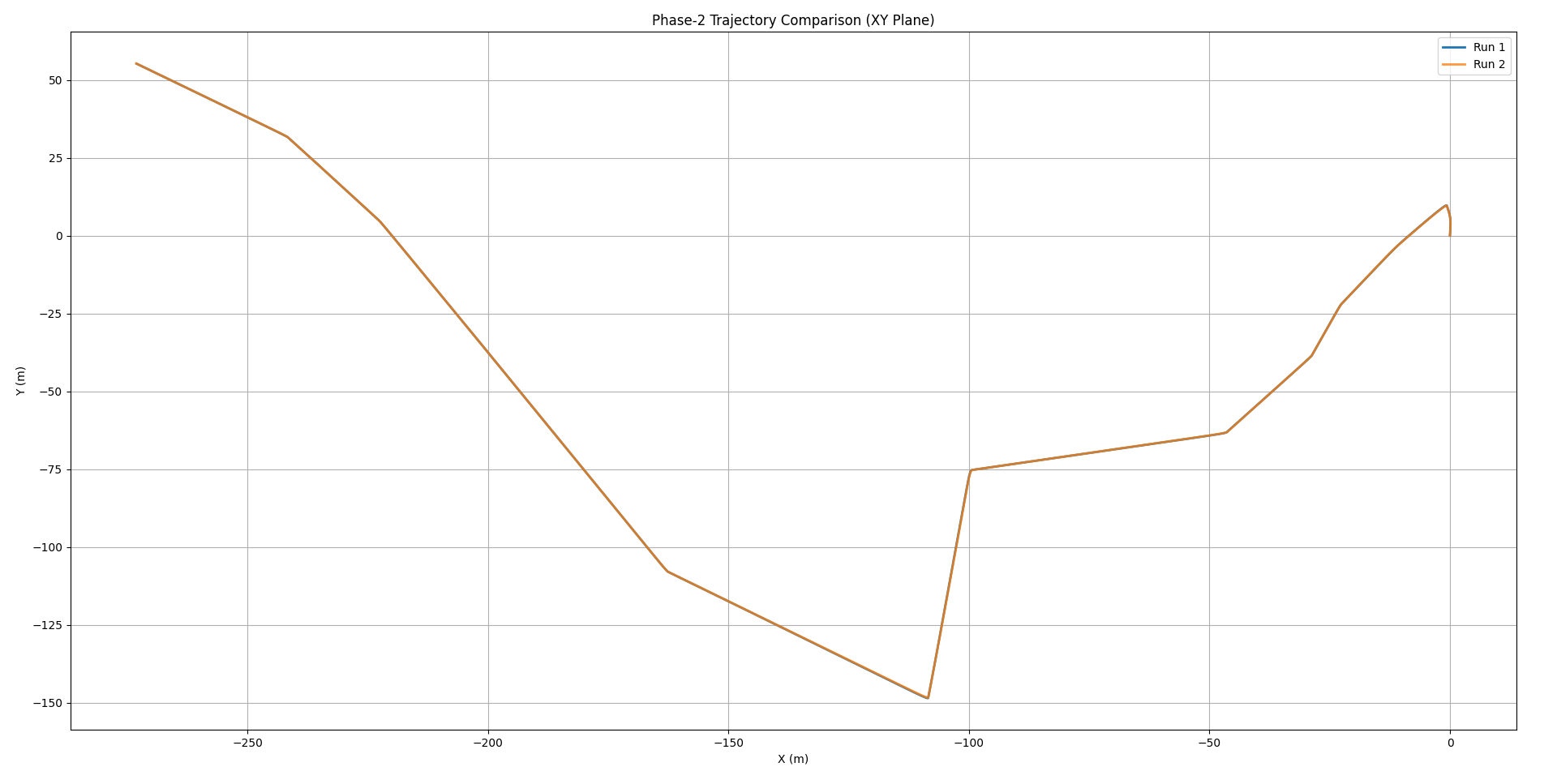
Run-1 vs Run-2 Lateral Path Overlap
Bounded Translational Deviation
- • Runs nearly overlap
- • No lateral divergence
- • No exponential growth
||Δp(t)|| < εTranslational error is strictly bounded over time.
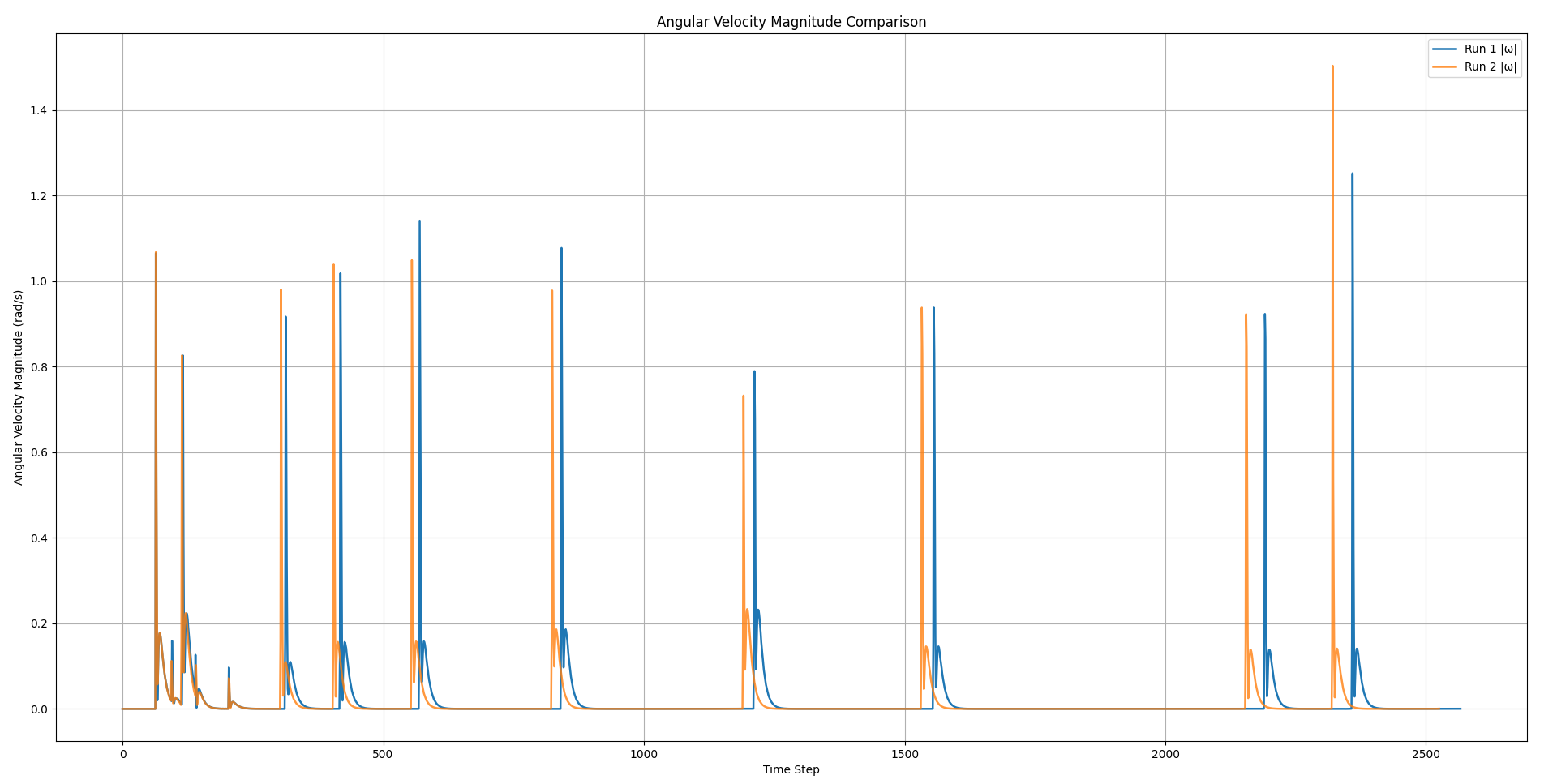
Angular Velocity Magnitude Over Time
Bounded Rotational Energy
- • Both runs tightly bounded
- • Transient spikes decay rapidly
- • No runaway instability
supt ||ω(t)|| < ω_maxMaximum angular velocity remains within safe operational limits.
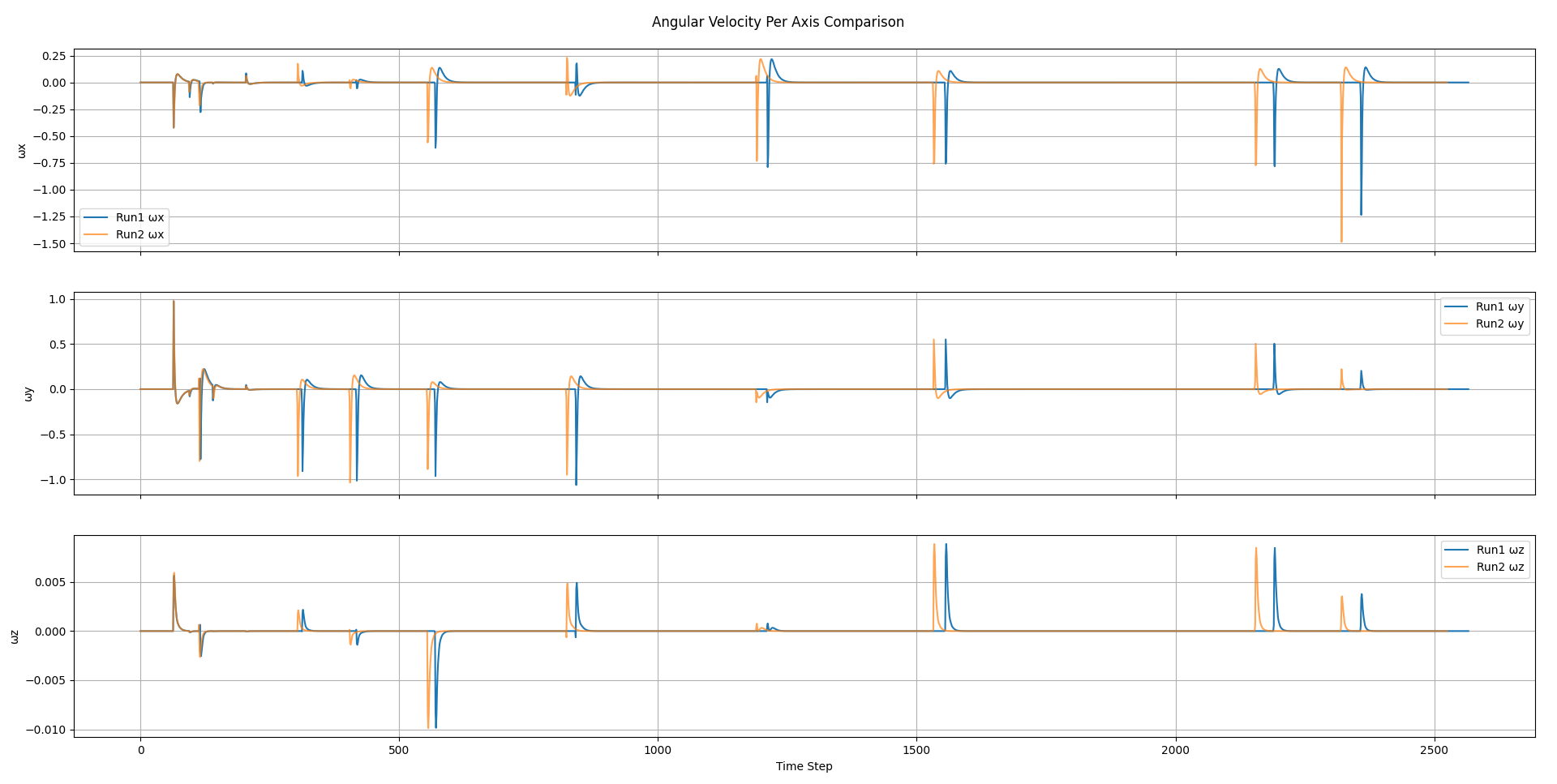
Per-Axis Velocity Breakdown
Axis-Specific Damping
- • Roll & pitch heavily damped
- • Yaw structurally stable
- • No cross-axis amplification
Var(ωx), Var(ωy) ↓Variance indicates significantly reduced oscillation.
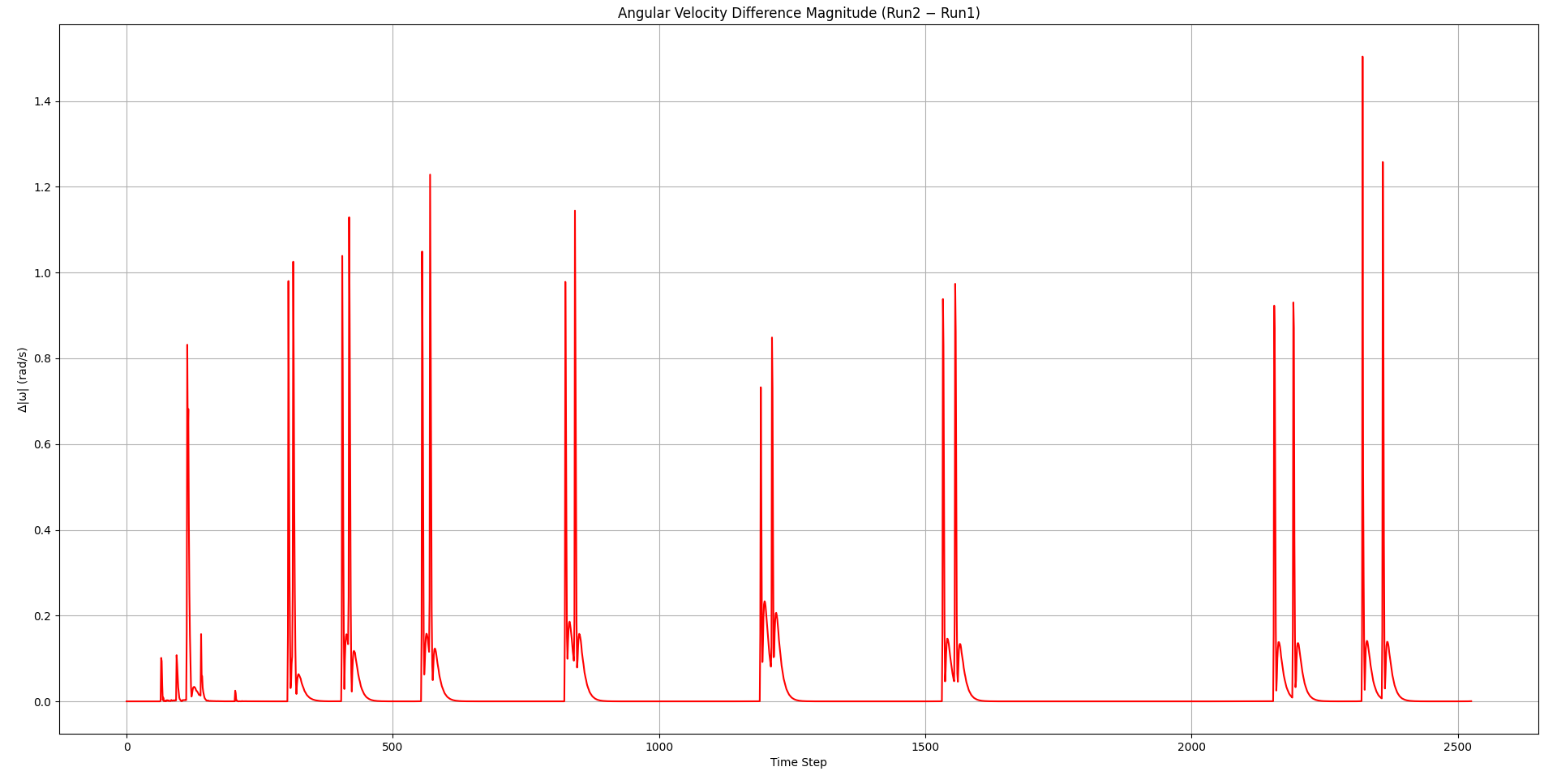
Velocity Deviation Magnitude Between Runs
Bounded Disturbance Energy
- • Low deviation baseline
- • Disturbance spikes recover rapidly
- • Controlled oscillatory behavior
∫ ||ω(t)||² dt < ∞Total accumulated discrepancy energy is bounded and finite.
Sensor Flow Consistency
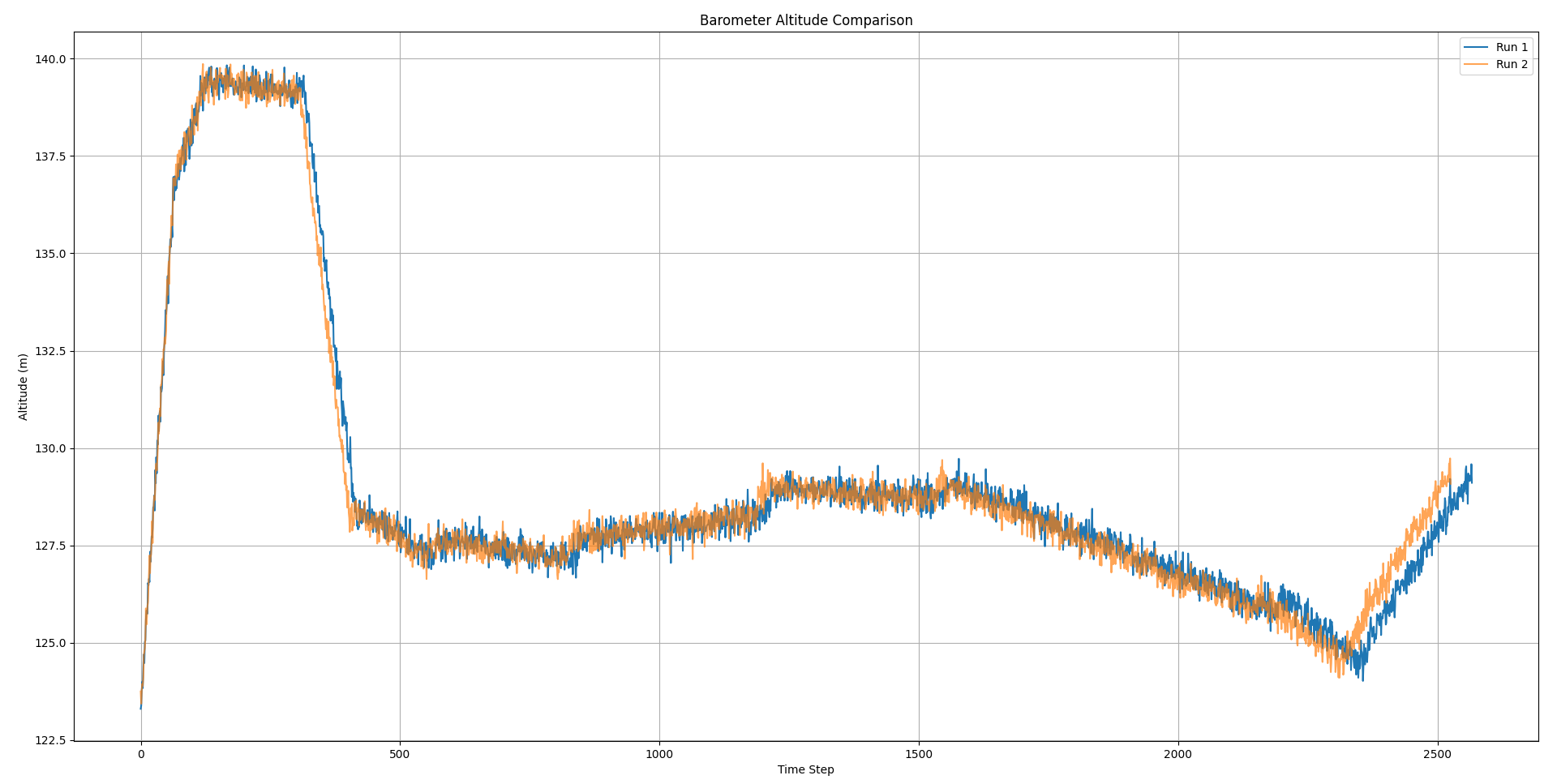
Barometer Altitude Output
RMSE Pos,Z = 0.3661
Vertical axis highly stable.
Minimal sensor drift.
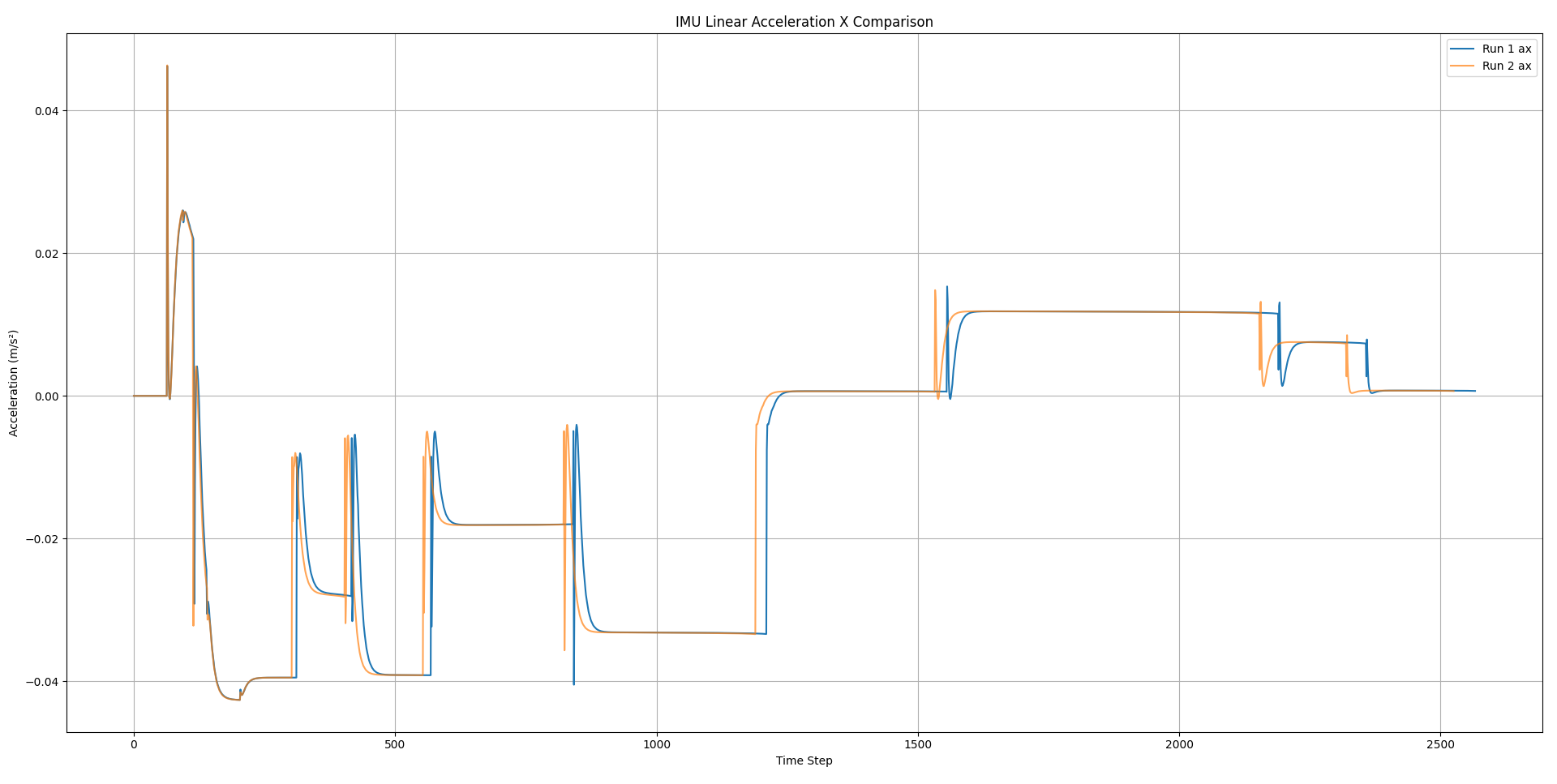
IMU Linear Acceleration (X)
Smooth acceleration transitions
No chaotic spikes.
Controlled torque response.
Mid-Evolution Evaluation Run
Simulation log generating the above deterministic and non-deterministic wind training metrics.
Var(ω) ↓
Variance Reduction
Stabilizes oscillation
||x(t)|| ≤ C
Bounded State
Prevent divergence
∫ ||ω(t)||² dt < ∞
Energy Finite
Decaying transients
Low RMSE_IMU
Low RMSE
Repeatable dynamics
Phase-2 Engineering Validation
Phase-2 confirms reduced rotational instability, improved damping behavior, and high repeatability across controlled disturbance injections, establishing quantitative stability improvement prior to stochastic robustness testing.
Phase-1
Baseline Instability
Baseline Instability
➔
Phase-2
Quantified Improvement
Quantified Improvement
➔
Phase-3
Multi-Wind Robustness
Multi-Wind Robustness